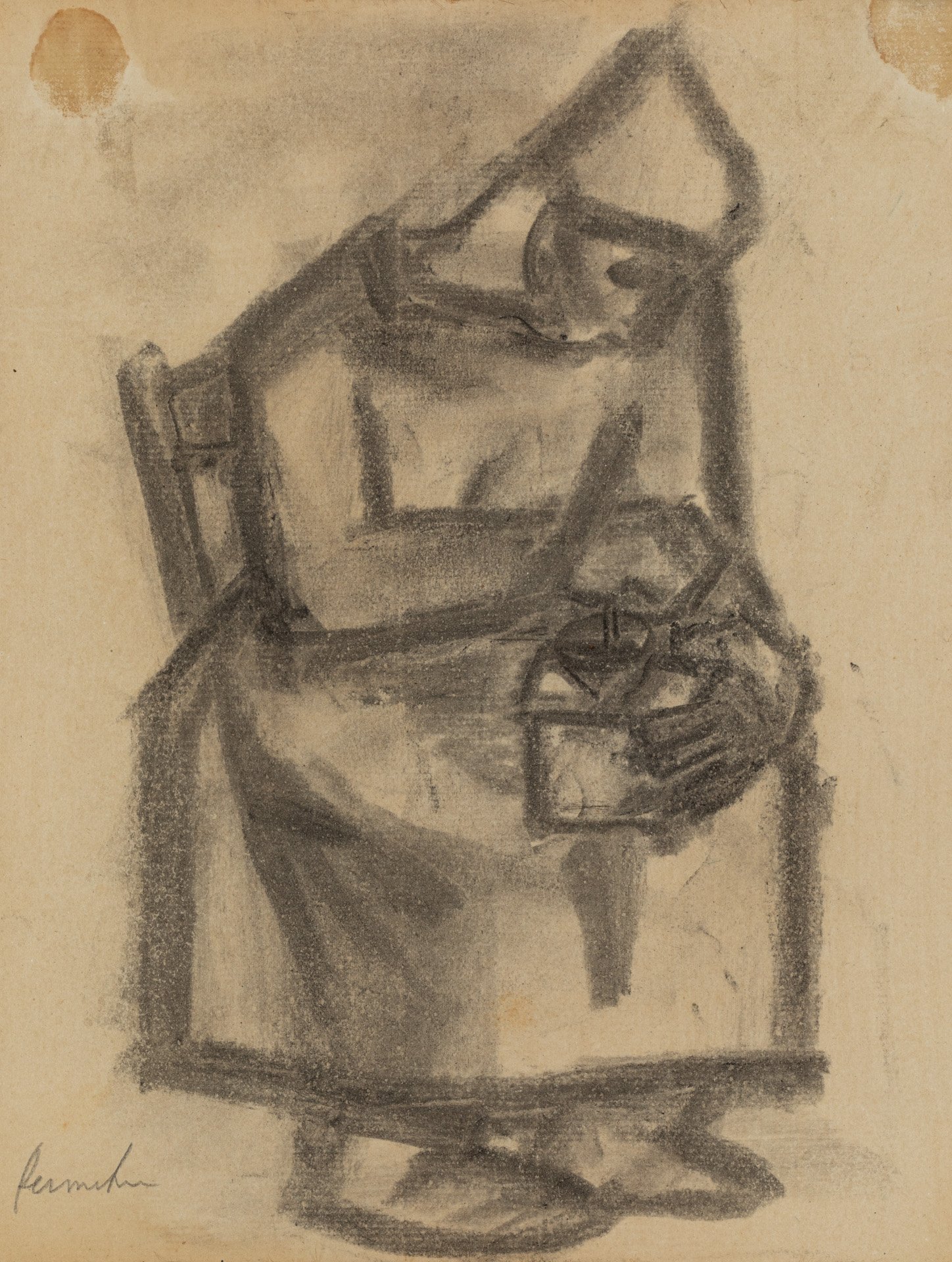
Constant Permeke
Constant Permeke (1886–1952) is considered, alongside Gustave De Smet and Frits Van den Berghe, as one of the most prominent figures of Flemish Expressionism. Permeke was the son of Henri Permeke (1849-1912), painter and drawing professor at the Academy of Ostend, and the first curator of the Museum of Fine Arts in Ostend. He studied at the Academy of Bruges and later at the Academy of Ghent. Before the First World War, Permeke — like De Smet and Van den Berghe —was still working within the Luminist and late Impressionist tradition.
Called to arms in 1914, he was sent to England after sustaining a severe injury that nearly led to the amputation of one of his legs. During these years his art evolved, definitively abandoning his initial luminist influences and moving towards Expressionism. The masterpiece marking this shift is L’Étranger (1916). His approach became more intimate and distinctive, with dark, earthy tones. Permeke’s style is characterized by the expressionist deformation of forms. This is especially visible in his depictions of workers, peasants, and pregnant women, such as in Étude de femme (1915).
After the war, Permeke lived between Antwerp and Ostend, drawing inspiration from maritime subjects and fishing scenes. During this period, De Smet and Van den Berghe frequently spent time at Permeke’s in Ostend. Unlike them, the latter never signed a contract with Sélection, which somewhat strained his relations with Paul-Gustave Van Hecke, the major promoter of Flemish Expressionism, although he remained on good terms with the movement’s theorist, André De Ridder. It was also during this decade that he purchased a plot of land in Jabbeke, where he built his house with a studio, completed in 1929, on the site where the Permeke Museum now stands.
In July 1930, the non-profit organisation L’Art Vivant was established, a society promoting contemporary painting and sculpture. The purpose of this association was to support modern artists at a time when the financial crisis was taking full effect. A first exhibition took place in January 1931 at the Galerie Georges Giroux. Constant Permeke was one of the participating artists. From these years until the early 1940s, Permeke revealed himself as a lyrical artist, whose painting revealed an increasing inclination toward abstraction.
From 1935 onwards, Permeke began sculpting. His preferred subject was the human body, mainly the female figure. Notable examples include Torso (1937) and Niobé (1946), inspired by the mythological figure, daughter of Tantalus. He was self-taught, working with cement and occasionally bronze — less concerned with the material itself than with the sacredness of the three-dimensional form.
In the 1940s, Permeke revisited many of his earlier themes, devoting considerable attention to large-scale female nudes on paper. One of the most intense creations of his late work, L’Adieu (1948), was inspired by the death of his wife and lifelong companion, after months of suffering. He died in 1952 in Ostend but was buried in Jabbeke, where a sculpture by George Minne was placed on his tombstone.