Pierre-Louis Flouquet
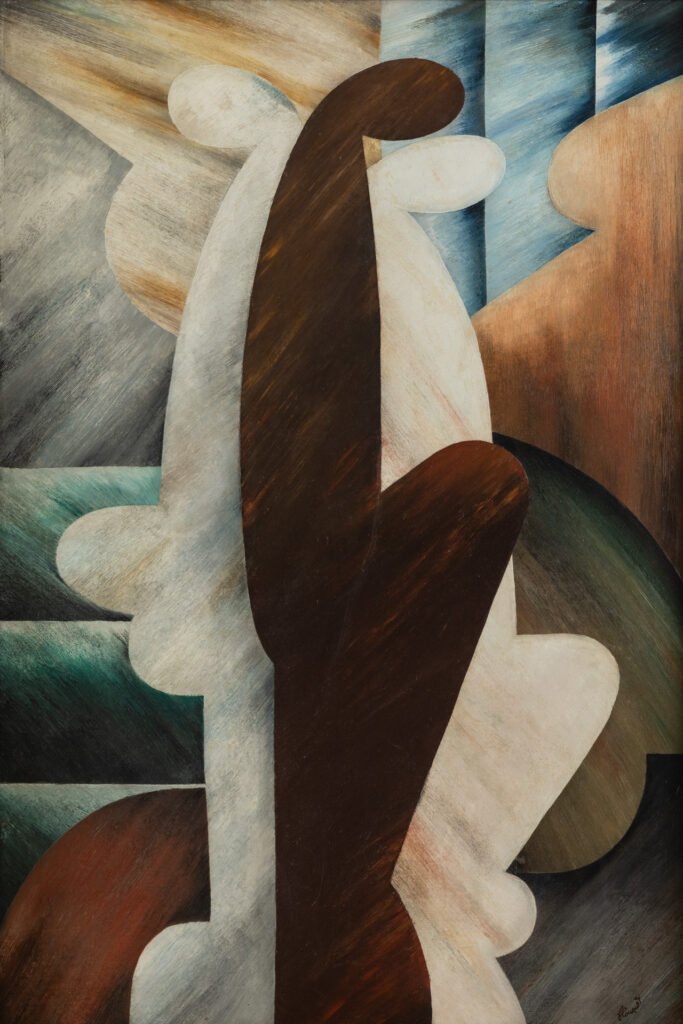
Pierre-Louis Flouquet (1900-1967) was born in Paris and moved with his family to Brussels in 1909. Although largely self-taught, he briefly studied at the Royal Academy of Fine Arts in Brussels, where he met artists such as Victor Servranckx and René Magritte. Flouquet and Magritte would later share a studio, a formative period during which Flouquet developed a pictorial language grounded in geometry and shaped by the intersecting influences of Cubism and Futurism.
In March 1920, Flouquet attended a lecture by the Dutch artist Theo van Doesburg, founder of De Stijl. This encounter marked a turning point, as he gradually moved toward “Pure Abstraction”, a conviction shared by many young artists, including Victor Servranckx and Marcel-Louis Baugniet, as well as the poet Pierre Bourgeois and his brother Victor, an architect. Together, the Bourgeois brothers and Flouquet founded the magazine 7 Arts in 1922, with the ambition of uniting art and society through modernism. One of its most prolific contributors, Flouquet wrote columns and exhibition reviews, while also organizing numerous events to promote the 7 Arts artists. That same year, architect Victor Bourgeois commissioned him to design abstract stained-glass windows for a group of houses of the Cité Moderne in Berchem-Sainte-Agathe.
Throughout the 1920s, Flouquet exhibited widely on the international stage — in Paris, Madrid, New York, Chicago, Buenos Aires, and Berlin, where he showed at the Galerie Der Sturm. For the gallery’s eponymous magazine, he also designed numerous covers. During this period, Flouquet’s work evolved primarily through a series of themes, including “Paysage plastique”, “Féminités”, “Composition”, “Formes” and “Construction”.
Around 1928, Flouquet turned away from “Pure Abstraction” toward a more figurative art with quasi-Expressionist accents, depicting religious scenes as well as satirical portraits. This phase proved brief: he soon abandoned painting to focus on poetry, literature, and the promotion of modern architecture. In 1931, he founded Le Journal des poètes and, from 1932 onward, directed the magazines Bâtir and La Maison, the latter established after the Second World War and dedicated to urban planning, architecture, and the related arts and technologies.