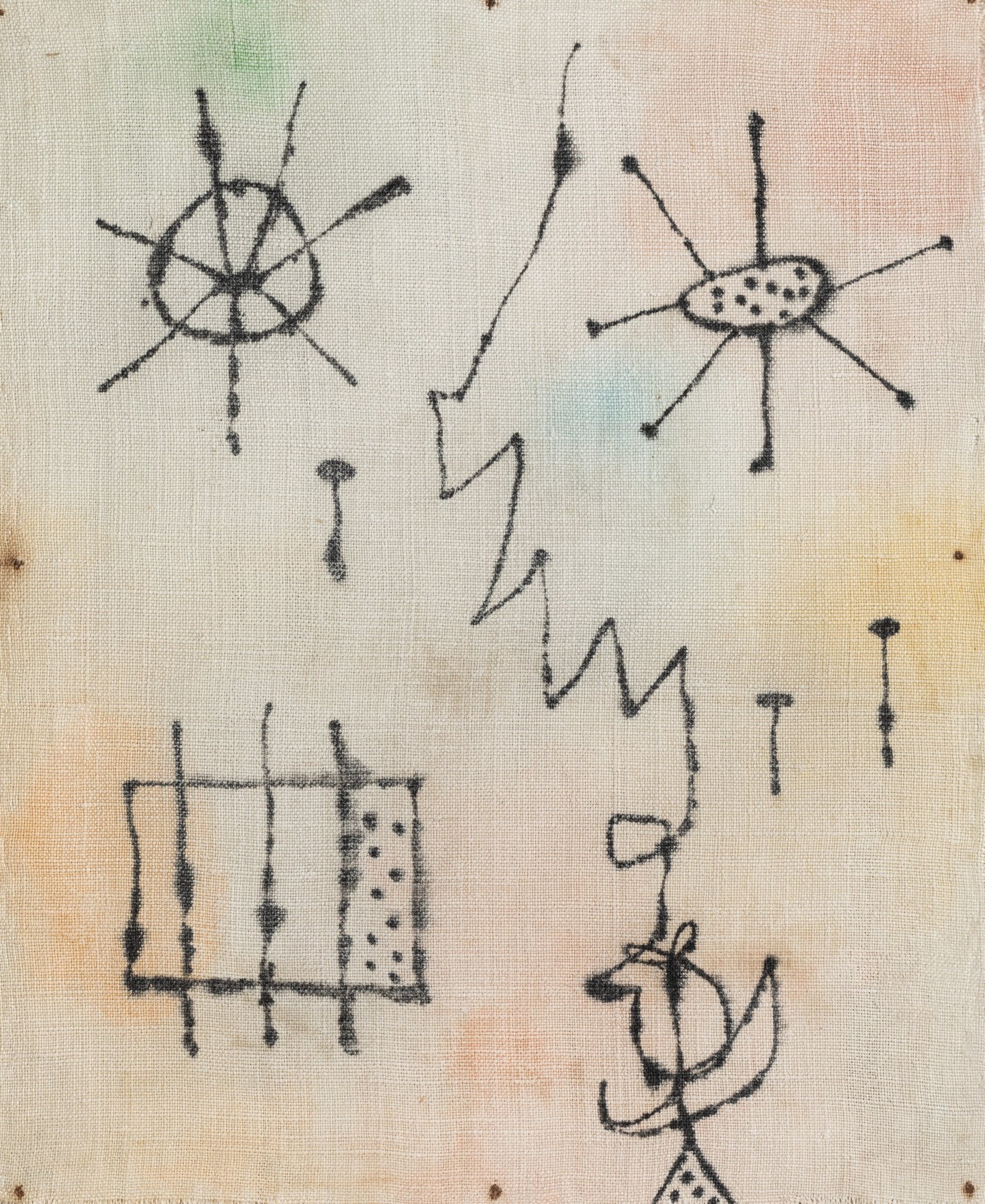
Joan Miró
A prolific artist closely associated with the history of Surrealism, Joan Miró (1893-1983) spent his life moving between Paris and his native Catalonia. The work of this “classic contemporary” artist encompasses landscapes, portraits, and still lifes, all marked by a constant search for a primary, essential gesture. His painting is animated by a tension between abstraction and figuration, and his large canvases—often dominated by the colour blue—evoke a deeply personal, dreamlike universe.
Joan Miró was born in Barcelona in 1893 into a family of goldsmiths and jewellers. At the age of fourteen, he enrolled in business school to satisfy his father, but soon lost interest and began attending art classes alongside his studies. At eighteen, he contracted typhoid fever and went to recuperate at the family farm in Montroig, Catalonia. It was there that he decided to devote himself entirely to painting, returning every summer thereafter.
Between 1912 and 1915, the young artist continued his training and discovered modern painting—particularly the work of Vincent van Gogh, the Fauves, and the Cubists—thanks in part to the gallery owner Joseph Dalmau, who exhibited works by the Parisian avant-garde. After the First World War, Miró moved to Paris, where he met Pablo Picasso in 1920, an encounter that brought him closer to Cubism. During the 1920s, he developed a freer pictorial language inspired by the landscapes and rural life of Montroig.
In his studio on Rue Blomet in Paris, Miró became closely associated with figures who would shape Surrealism, including André Breton, Robert Desnos, Michel Leiris, André Masson, Max Jacob, Jacques Prévert, Louis Aragon, and Paul Éluard. He was among the signatories of the 1924 Surrealist Manifesto and participated in the first Surrealist exhibition in 1925. In response to the joyful and, in Breton’s words, “childlike” dimension of his art, Miró expressed a desire to “kill” painting, leading him to create his first painting-objects, as well as collages and assemblages using found materials. During the 1930s, he gained increasing recognition in the United States, notably through Pierre Matisse, son of Henri Matisse and an influential Franco- American art dealer.
The Spanish Civil War, followed by the Second World War, forced Miró to relocate several times and placed him in a precarious financial situation. In the 1950s, he had a studio built in Palma de Mallorca, where he began creating his first large triptychs. He also produced major works in collaboration with the ceramicist Josep Llorens Artigas, including the monumental ceramic walls for UNESCO Headquarters in Paris.