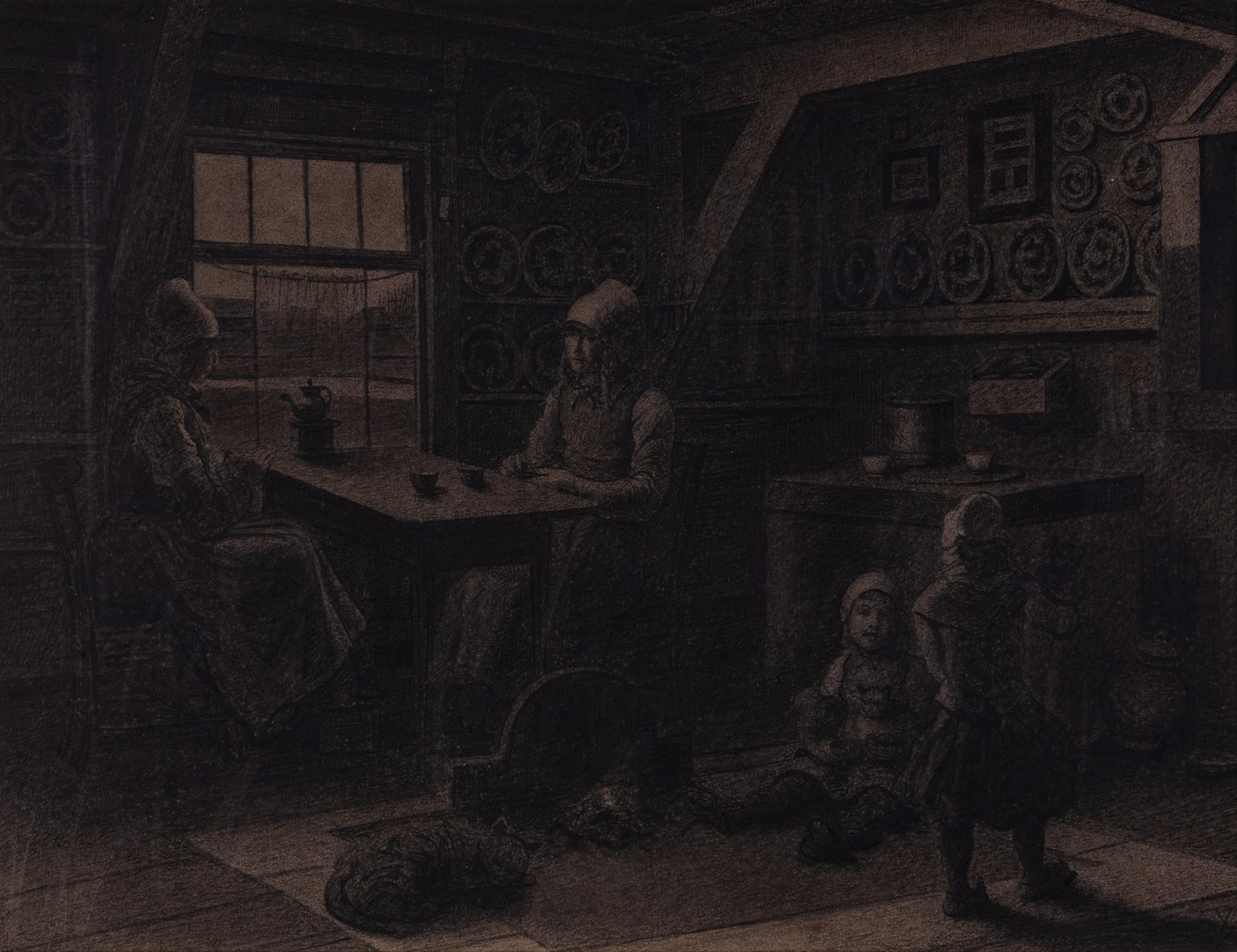
Xavier Mellery
The son of the royal gardener at the Palace of Laeken, Xavier Mellery (1845-1921) began his artistic training in 1860 at the Royal Academy of Fine Arts in Brussels. In 1870, he won the Prix de Rome, which allowed him to travel to Italy via Germany. Upon his return, he rented a studio in Brussels from Félix Mommen, a patron and supplier of artists’ materials. Known as the Ateliers Mommen, this remarkable complex — combining studios, exhibition spaces, a frame workshop, and a shop — provided a vibrant environment for artistic exchange.
Mellery’s early ambitions were oriented toward decorative and allegorical painting. He sought to revive the tradition of Renaissance fresco painters, drawing inspiration from Pierre Puvis de Chavannes and the Pre-Raphaelites. This aspiration gave rise to his finely crafted allegories set against gold backgrounds. He later distinguished himself through his remarkable drawings — positioned at the crossroads of Symbolism and pure poetry — through which he intended to express “the soul of things”.
He strove, often with a certain anxiety, to convey the inner life or psychic essence of the objects that surrounded him. Mellery had a particular fascination with the interplay of light and shadow, which played a central role in this search. His works, imbued with a Symbolist spirit and a quiet sense of the sacred, made a lasting impression on Fernand Khnopff, who began studying under him at the Ateliers Mommen in 1875.
Xavier Mellery’s staid in Zeeland around 1878–79, where he settled thanks to the Belgian novelist Charles De Coster (1827–1879), who had invited him to illustrate his story about the island of Marken for the journal Le Tour du Monde. At that time, still modest and deeply rooted in its traditions, the isolated island struck the artist with its introspective and melancholy character. This fishing village, seemingly frozen in time, became a recurring subject that Mellery revisited over the years. The traditional costumes — reminiscent of sixteenth-century dress and worn by the island’s secluded inhabitants — fed into an idealised vision of life, similar to the one he would later encounter in Bruges and among the Beguines.
It was during this stay that Mellery’s art became more pared-down and introspective. He would travel very little thereafter, spending most of his life in a secluded house surrounded by gardens on the edge of the Royal Palace of Laeken. There, he sought to recreate the formative experience of Marken, drawing inspiration from his immediate surroundings.