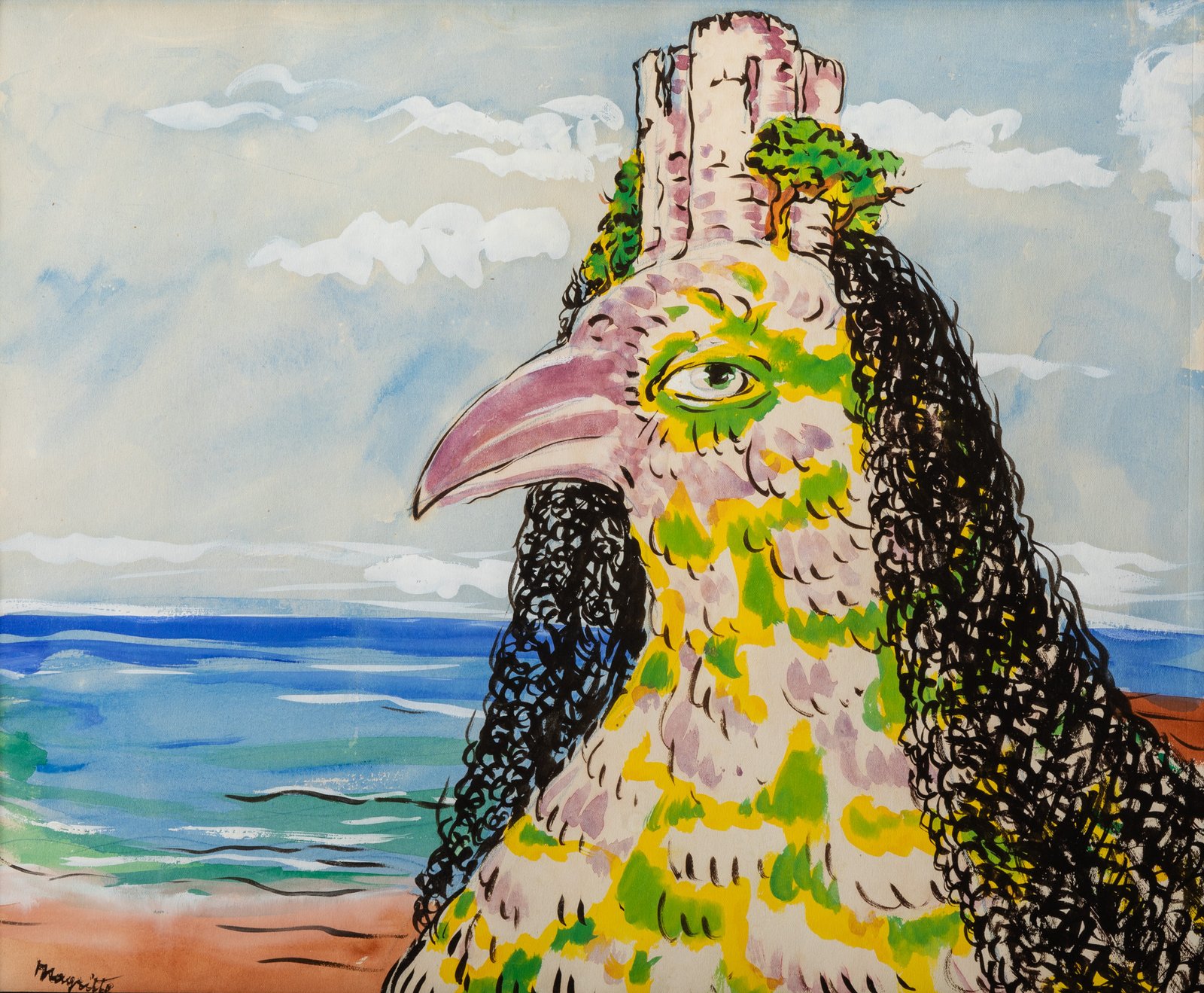
René Magritte
René Magritte (1898–1967) developed a style that became instantly recognisable from his first paintings in the 1920s. He employed a neutral mode of representation to create unsettling images, featuring recurring motifs such as apples, pipes, bowler hats, and clouds. Through his constant interplay between object and representation, his engagement with language, and his sharp sense of humour, Magritte pushed the boundaries of pictorial imagery. Although he maintained close ties with artistic movements such as Surrealism, he remained distant from psychoanalysis throughout his life, preferring a philosophical approach.
Born in Lessines, the Belgian artist René Magritte began taking painting classes as early as 1910. He was influenced by film posters, cartoons, and the character of Fantômas. His father supported his move to Brussels in 1915, where Magritte enrolled at the Royal Academy of Fine Arts in Brussels. The young painter soon began to earn a living through various commissions, including advertising posters and wallpaper designs. After the First World War, he married Georgette Berger, who would become the model for many of his works.
He began his career influenced by Futurism and Cubism. It was through his friend Marcel Lecomte that he discovered the paintings of Giorgio de Chirico, about whom he famously remarked: “My eyes saw thought for the first time.” He was part of the Belgian Surrealist group founded in 1926 by Paul Nougé, a scientist by training, which lent his work a distinctly analytical dimension. Between 1927 and 1930, his time in the Paris region brought him closer to the Parisian Surrealists and André Breton, although the two soon fell out, Breton deeming Magritte’s lifestyle “too bourgeois”.
At that time, Magritte adopted a deliberately academic style, producing powerful, mysterious, even unsettling images. He confronted the viewer with a sense of unease, heightened by the precision of his technique. It was also in Paris that he created his first “word paintings”, in which he combined the image of an object with an arbitrary inscription.
In 1932, he painted Les Affinités électives, marking the beginning of a new phase in his work: the egg replaces the bird in the cage, and logic supplants the “chance encounters” cherished by the Surrealists. This approach is also evident in the famous Le Modèle rouge (1935), a small-format work depicting shoes shaped like human feet. This new period saw an increase in his output and a growing number of exhibitions.
Until the end of his life, Magritte continued to subvert expectations, from his “Renoir period” (1943–1945), during which he adopted an Impressionist style, to his “Vache period” in 1948, a brief six-week span during which he produced around 28 works. Today, his pictorial inventions are deeply embedded in the collective unconscious.