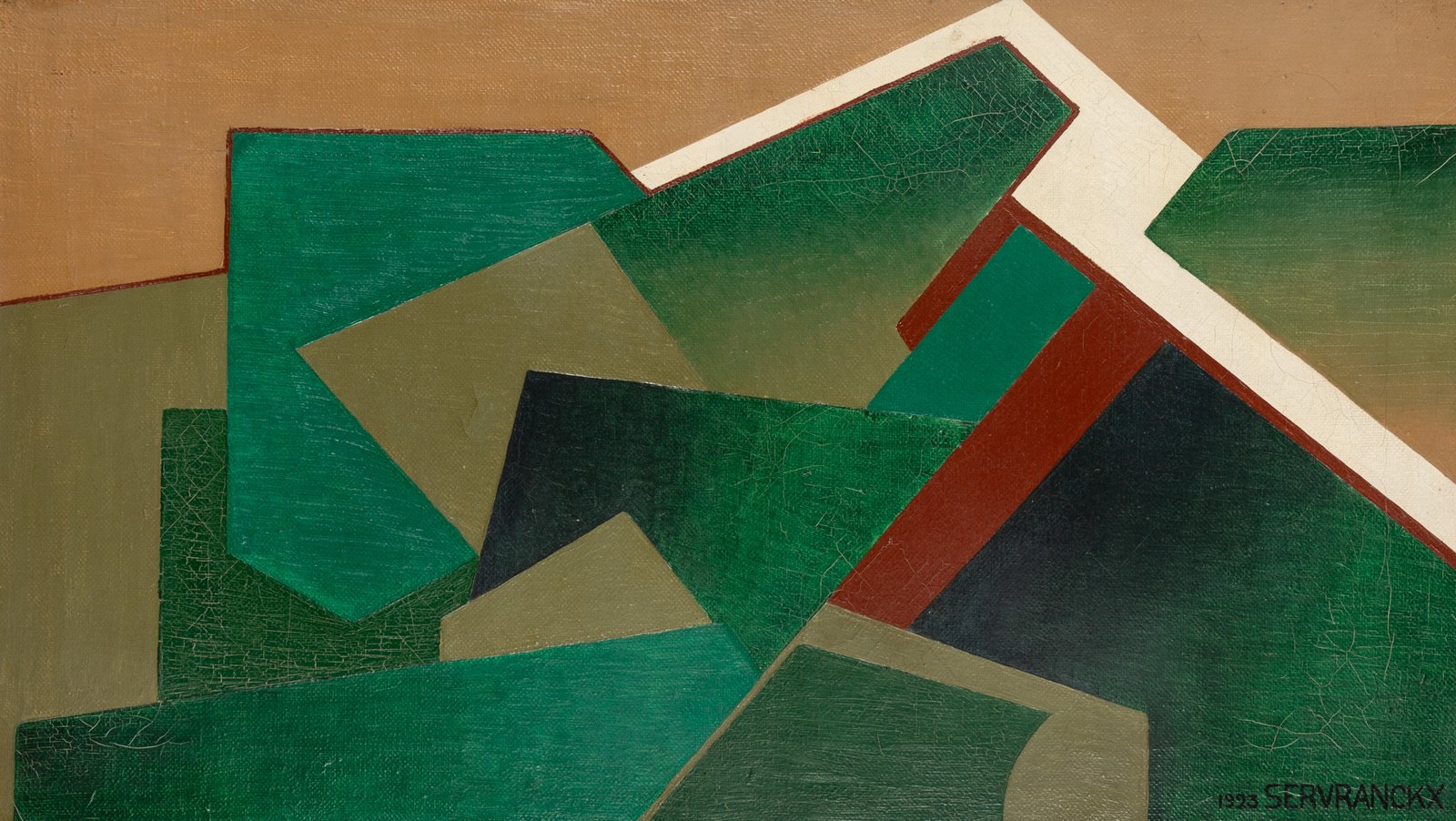
Victor Servranckx
The Belgian artist Victor Servranckx (1897-1965) developed a language of geometric abstraction. His fascination with mechanics and the factory, filtered through an artistic vision, extended far beyond the canvas and encompassed a fusion of disciplines. Servranckx exemplifies the versatility of the modern artist: painter, manifesto writer, wallpaper designer, architect, cabinetmaker, and more — demonstrating how the modernism of the 1920s genuinely permeated all aspects of daily life.
During the First World War, while studying at the Royal Academy of Fine Arts in Brussels, Servranckx met René Magritte, Karel Maes, and Pierre-Louis Flouquet. After completing his studies in 1917, he joined the Peters-Lacroix wallpaper factories as a designer, where his father headed the office.
In March 1920, the Dutch artist Theo van Doesburg, founder of the De Stijl movement, gave a lecture in Brussels at the Centre d’Art du Coudenberg. The presentation proved revelatory for Servranckx and his circle, including the poet Pierre Bourgeois, his brother Victor, an architect, and the artist Marcel-Louis Baugniet. Inspired by the lecture, the Bourgeois brothers conceived a periodical aimed at promoting “modernist penetration”,
which led to the launch of 7 Arts in 1922, connecting art and society. Initially keeping his distance, Servranckx signed, in the same year, a short manuscript with Magritte entitled L’Art pur. Défense de l’esthétique, which was never published. He soon became actively involved in the 7 Arts group, participating in events such as the Salon de La Lanterne Sourde in 1923.
Servranckx then worked on numerous projects in Belgium and abroad, combining art, architecture, and applied arts, including the International Decorative Arts Exhibitions in Paris and Monza in 1925. The following year, Marcel Duchamp invited him to participate in an exhibition organized by the American artistic collective Société Anonyme, whose founders included Man Ray and Katherine Dreier. Around the same time, Servranckx began moving away from Constructivism, blending diverse styles and techniques, and combining abstraction with cosmic surrealism in biomorphic compositions.
The purest and most radical paintings of his oeuvre were primarily those produced before this stylistic shift. He nevertheless continued throughout his career to give his works neutral titles — “Opus”, followed simply by a number and a year — as if they were products of a new era, reinforcing their abstract nature. A true pioneer of “Pure Abstraction”, Servranckx developed, between 1922 and 1924, airy creations based exclusively on geometry, conceived as spiritual inventions intended to serve a collective art, accessible and understandable by all.